
1 in 42,372: The Brutal Mathematics of Norwegian Tinder
If anyone tells you dating is an art, they are lying. It is a ruthless mathematical equation, and the numbers are completely out to get you. Here is the exact calculation of your doom, laid…
If anyone tells you dating is an art, they are lying. It is a ruthless mathematical equation, and the numbers are completely out to get you. Here is the exact calculation of your doom, laid…

If you’ve ever tried adding a new voice package to Windows—whether it’s Arabic, Japanese, Norwegian, Hindi, or any other language—only to watch the installation silently fail, you’re definitely not alone. It’s one of those small…
For a long time, AI video generation was stuck in the realm of impressive but brief 5-second B-roll clips. If you wanted to make a short film, a YouTube explainer, or a comprehensive tutorial, you…
We have all experienced the magic of AI image generation, but the frontier has officially shifted. It is no longer just about generating a beautiful static image or swapping out a background. Today, the cutting…
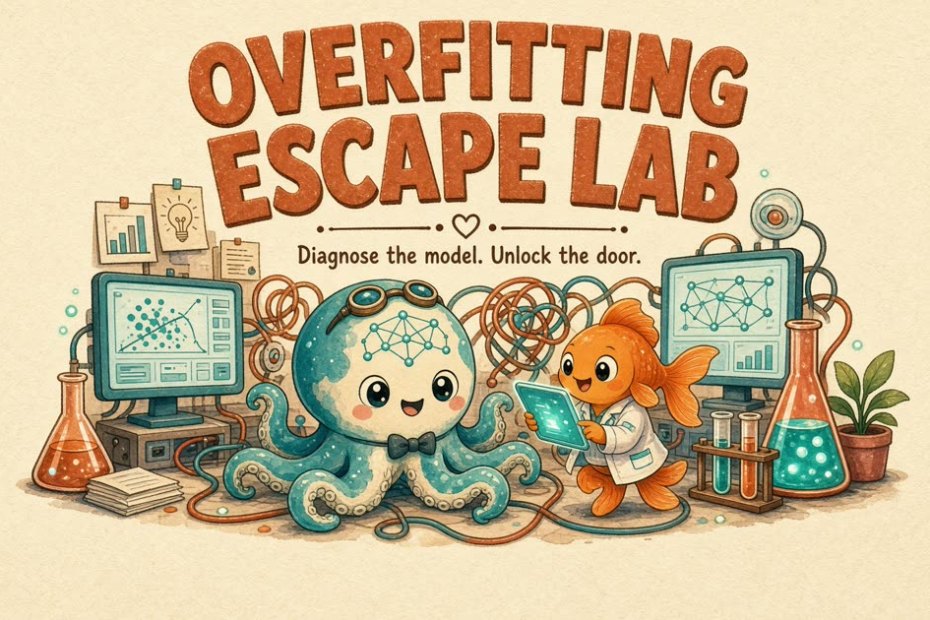
“Overfitting Escape Lab” is an interactive escape-room style web app. The player is trapped in a colorful, cartoonish AI research lab. Each room represents a common machine learning failure (overfitting, vanishing gradients, data leakage, bias,…
They’ve been roaming the Earth for over 200 million years (yes, they hung out with the dinosaurs), and in that time, they’ve quietly evolved into some of the most bizarre creatures on the planet. Before…

Grok Build is xAI’s 2026 push to turn Grok from a conversational assistant into a builder. It has two closely related faces: a consumer Build Mode that turns a sentence into a live website, app,…
Installing FSL Run this in your terminal: (or with sh if you prefer): What happens: When it finishes you should see: After installation – set up the environment Close the terminal and open a new…
While both are AI-powered video tools by Google, they serve entirely different purposes and audiences. The short answer: Google Flow is an advanced AI creative studio for visual artists and filmmakers to generate and manipulate…
The CO-STAR Framework Use this structured method to provide all necessary context for a high-quality response: Prompts to Reduce Hallucinations These strategies help ensure the AI sticks to the facts rather than “improvising”: Few-shot prompting:…
Tree of Thoughts (ToT) prompting is a technique where you ask the AI to generate multiple reasoning paths (branches), evaluate them, and then expand on the most promising ones. Unlike “Chain of Thought” (which follows…
Designing a high-quality survey is about more than just writing questions; it’s about minimizing bias, ensuring logical flow, and maximizing completion rates. Here is a guide on how to use AI prompting at every stage…
The Circular Reporting Effect: This is a growing problem in the age of generative AI — a self-reinforcing loop where fake information created by one AI ends up being treated as real by another AI…
Suppose that I put this prompt into Nano banana to create an image for a scientific paper Gemini output this image which looks very undesirable with too many redundant extra details. Writing prompt to edit…
If you’ve ever asked an AI to summarize a long article, you’ve probably experienced a common frustration: the summary is either too vague, misses the most important facts, or is padded with repetitive filler like,…
We’ve all been there. You have a big project, you open up your favorite AI tool, and you dump everything you need into one massive prompt. You ask for a marketing strategy, a breakdown of…
Using AI for difficult emails is a superpower because it removes the emotional tax from the task. When you are stressed or defensive, it’s hard to write clearly; AI, having no ego, can draft a…
Using a pre-training corpus derived from incident databases for safety fine-tuning is a promising, real-world-grounded approach to embedding AI failure knowledge directly into models. It draws on databases like the AI Incident Database (AIID), OECD…
In 2026, AI creative tools have exploded. Whether you’re a designer, marketer, filmmaker, or developer, choosing the right platform for image, video, and audio generation matters more than ever. Today we compare the big five:…
As of March 2026, the AI landscape has matured into clear specialists rather than one-size-fits-all winners. Google’s Gemini 3.1 Pro, Anthropic’s Claude Opus 4.6, xAI’s Grok 4, OpenAI’s ChatGPT (GPT-5.4), and Google’s specialized NotebookLM each…
Download on Hugging Face. Description is in the paper A large-scale heterogeneous 3D magnetic resonancebrain imaging dataset for self-supervised learning FOMO60K is a subset of FOMO300K that includes 60,529 MRI scans collected from 13,900 MRI…
If you’ve ever asked an AI to summarize a long article, you’ve probably experienced a common frustration: the summary is either too vague, misses the most important facts, or is padded with repetitive filler like,…

The Bonferroni correction is a statistical method used to reduce the risk of Type I errors (false positives) when you run multiple hypothesis tests. Every time you test a hypothesis, there’s a chance you’ll incorrectly…

Type I Error (False Positive) You reject a true null hypothesis — you conclude something is happening when it actually isn’t. Example:A medical test says a patient has a disease, but they actually don’t. Type…

🧩 What “Independent Samples” Means Two samples are independent when the individuals in one group have no relationship to the individuals in the other group. This is the setup for the independent‑samples t‑test, also called…

A one‑sample t‑test checks whether the mean of a single sample is significantly different from a known or hypothesized population mean. It answers the question: “Is my sample mean different enough from the population mean…

A t‑test is a hypothesis test used when you want to compare means but you don’t know the population standard deviation and your sample size is small. It’s used for: One‑sample t‑test → compare one…


